Fake Billing Data Generator
ByLegal InnovAI LLCPricing & Profitability·Law Firm / Legal Business Management·Jurisdiction-neutral
About this tool
Generates structurally and analytically realistic synthetic time-and-billing data for a defense-side / hourly law firm. Use it to: Stand up a demo or sandbox of any pricing, profitability, or BI tool without exposing real client data. Train staff on matter-management, billing review, or finance workflows against data that looks and behaves like the real thing. Develop and stress-test other skills in Legal InnovAI's Counsel Commons pricing-and-profitability skill suite (matter portfolio rankings, client rollups, partner book reviews, deep dives) against repeatable, known-shape datasets. Build internal proofs-of-concept without waiting on a data-export from your billing system. Or, use it to build and test your own AI skills without needing to input real firm data. What it produces: Time entries with UTBMS task and activity codes, timekeeper roles, realistic narrative blurbs, rates, and hours distributions calibrated to practice-area norms. Expense entries with practice-area-specific category distributions (travel, expert witnesses, court costs, e-discovery vendors, etc.). Invoice and payment records with realization, write-down, write-off, and aging behavior consistent with real defense-side firm dynamics. Output as an Excel workbook (default) or CSV, in a schema fully compatible with the rest of Legal InnovAI's pricing-and-profitability suite of skills on Counsel Commons. What it is not: Not a billing system. The output is fake by design; do not commingle it with real timekeeping data. Not for plaintiff / contingency firms — use the companion fake-plaintiffs-billing-data-generator skill for that economics model. Not a substitute for actual financial reporting or actual matter pricing decisions. Outputs require professional review. The data is synthetic and calibrated for plausibility, not accuracy against any specific firm's books. Anyone using this output to validate a pricing decision, profitability conclusion, staffing plan, or financial control should review the assumptions, distributions, and edge cases before relying on it.
Preview before you buy:
Note: the skill is fully interactive — when you run it, it will walk you through an 11-question intake covering timekeeper titles, firm-size band, average rates per title, practice areas, years of history, client-count band, fee-arrangement mix, billed and collected realization targets, output format, billing system to mimic, and a reproducibility seed. You don't have to know any of these answers up front — every question has a default you can choose. Skip the intake entirely and the skill will generate a 3-year, mid-size firm dataset with litigation / corporate / real-estate practice areas in CSV format.
You'll get back a zip named billing-data-SYNTHETIC-DATA-NOT-REAL.zip containing a set of CSVs covering timekeepers, clients, matters, time entries (with UTBMS task and activity codes), expenses, invoices, payments, rate history, and a validation-stats sheet — plus a README and a column-by-column glossary. The CSVs are the canonical output; an Excel workbook wrapper is available on request.

Every name in the dataset is a numbered placeholder — Client 7, Matter 42, Person 113, Vendor 9, Docket 4 — and numbering is stable across tables so foreign-key references stay consistent. Time-entry narratives are generic ("Review documents", "Draft correspondence") with placeholders for any party, court, or witness reference. Industries are generic labels. Office locations are city/state only. No phone numbers, emails, street addresses, SSNs, EINs, bar numbers, or real proceeding details appear anywhere.

The data is calibrated, not random — rates respect title bands and round to the nearest $5, leverage ratios reflect the practice areas you chose, realization lands within ±3% of your targets with realistic dispersion across matters and clients, collection lag and write-off behavior vary by AR risk tier, and matter lifecycles match practice-area norms.

Volume scales with your inputs (firm size × years × utilization). For typical mid-size firm parameters and 3 years of history, expect a substantial multi-table dataset that's representative of a real firm's books — large enough to exercise downstream pricing, profitability, and BI tools, small enough to open in Excel.

The README records every parameter you used plus the random seed, so re-running with the same seed produces a byte-identical dataset — useful for repeatable demos, tests, and benchmark comparisons.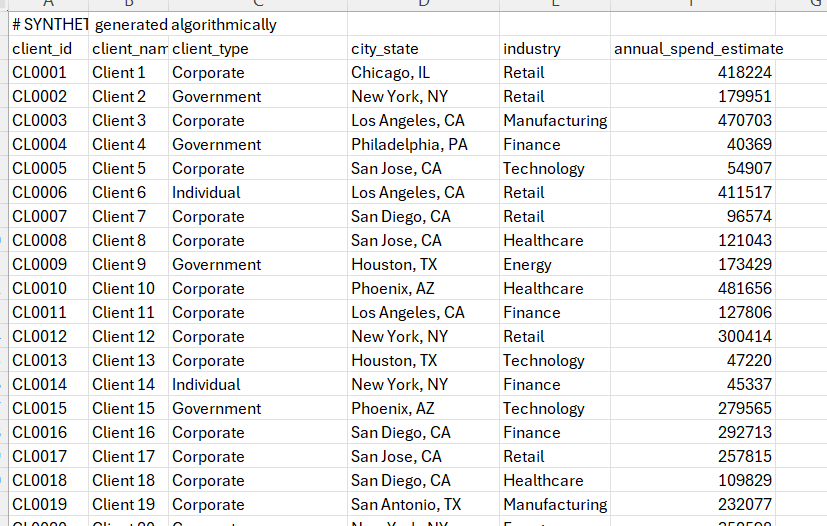
sample Client data
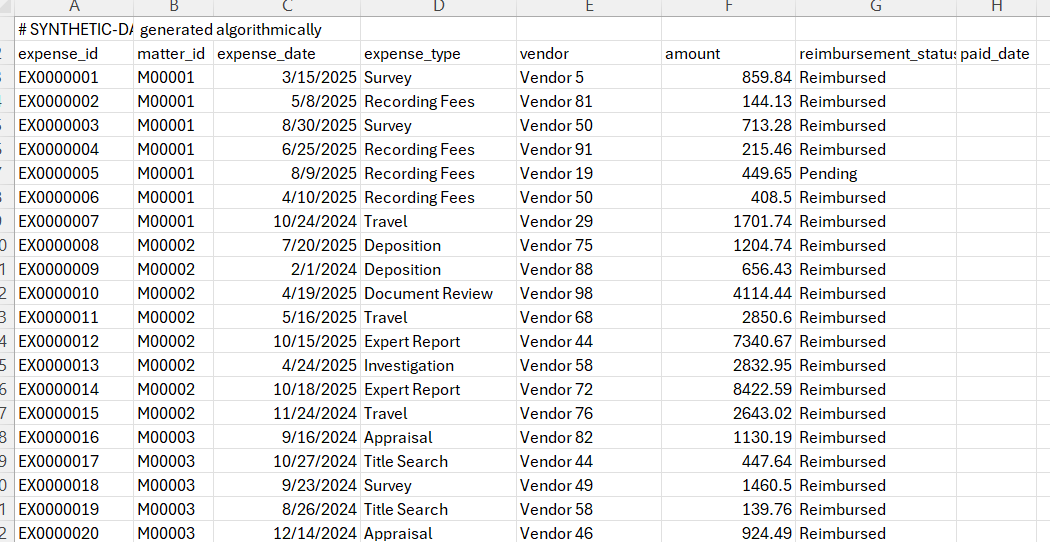
sample Expense data
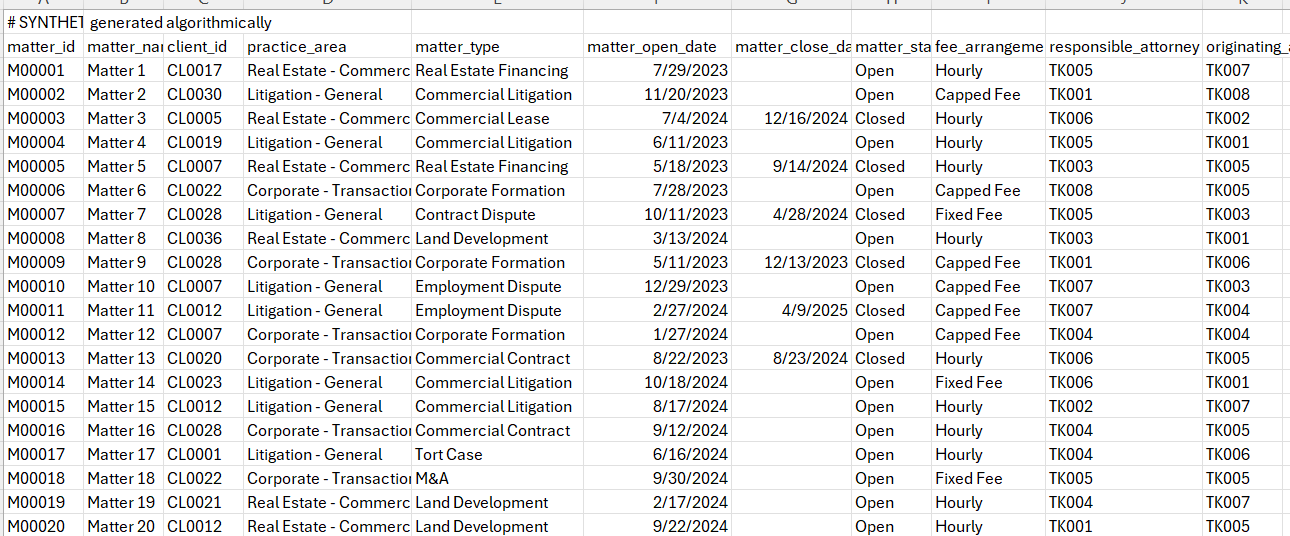
sample Matters data
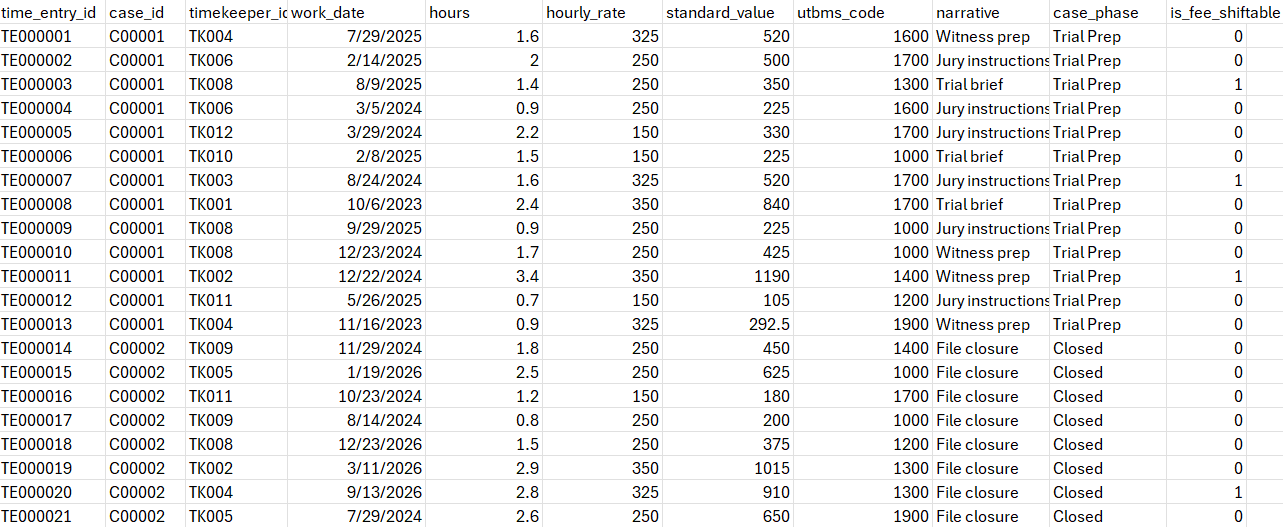
sample Time Entry data
Sanitized example, not professional advice. All sales final — use the preview to confirm fit before purchase.
Compatible models
The author has tested this tool on the providers below. The specific model list updates automatically as providers ship new models or retire old ones. Compatibility with providers not listed below is not guaranteed — the tool may not produce equivalent results outside the tested set.
Data handling
Seller of record
- Business name
- Legal InnovAI LLC
- Entity type
- Verified business (Stripe-KYC'd)
- Location
- Colorado
This is the party you have a software-license contract with. If you aren't satisfied with the tool, please contact this party directly to work it out.
Version history
- v1.0.3Current2026-05-22
- v1.0.22026-05-14
Cost schemas added for improved profitability analysis
- v1.0.12026-05-13
Fixed cross-table linking
- v1.0.02026-05-12
Existing buyers receive new versions free of charge. Pin to a specific version from your library if your workflow needs the exact bundle behavior of an earlier release.
Buyer reviews
- ★★★★★Colin L.Legal Operations·2026-08-15·Performed as described
Impressive. Easy to use and run and remarkably informative!
- Tools are starting points, like templates. Read every file in the bundle before running, modify for your workflow, and assess safety and legal implications for your use case.
- Outputs vary run-to-run. Generative AI is non-deterministic by design — the same tool on the same input can produce different results, and outputs can vary across sessions, model versions, and provider load conditions. Your input will differ and your model may differ, so you should expect your output to vary from the example above. Variance is normal, not a defect.
- All sales final. Tools are immediately downloadable digital goods.