Lateral-Hire ROI Calculator
ByLegal InnovAI LLCStrategy·Law Firm / Legal Business Management·Jurisdiction-neutral
About this tool
A hosted browser calculator for stress-testing a lateral hire deal before the hiring and compensation committees make the call. Built for managing partners, COOs, finance directors, hiring and comp-committee members, and legal-ops leads at AmLaw and mid-market firms. What it's for Having a model upon which to have the classic difficult conversation in lateral hiring: deciding whether the package on the table is defensible given what's likely to actually happen — not what the candidate represents will happen. Most lateral deals that lose money lose it for one reason. This calculator forces that reason into the committee's structured pre-read. What you get • A populated one-page committee pre-read covering the deal economics, a calibrated downside view, and a structured-protection menu. • The single headline metric that reframes the conversation from "do we like this person" to a defensible economic question the committee can actually argue about. • A multi-axis stress view so the committee can identify their honest believed-likely outcome and their honest downside, then decide whether the downside warrants special hiring terms. • Defaults calibrated against published industry research — sources cited on the printed page. Every default is editable. Where firm-internal lateral data exists, it replaces the industry defaults. • One-click print to PDF as a clean multi-page memo suitable for the committee packet. Privacy Runs entirely client-side. The page makes one outbound request on initial load (typography), then nothing. Served under a strict Content-Security-Policy that blocks fetch, XHR, WebSocket, and form submissions at the browser level — so any subsequent attempt to send what you typed somewhere fails before the data leaves your browser, not because the code politely doesn't try. No third-party trackers, analytics, or telemetry. Candidate identity, current firm, and client names are not collected or asked for — inputs are role-level and economic, intentionally. What it is NOT • Not a hire / no-hire recommendation. The output is a structured pre-read; the committee decides. • Not predictive of any individual candidate's outcome. Industry benchmarks are aggregates; your candidate may perform very differently. • Not a substitute for bar clearance, conflicts review, reference calls, cultural-fit assessment, or work-product sampling. • Not legal, financial, HR, or other professional advice. Outputs require professional review.
Preview before you buy:
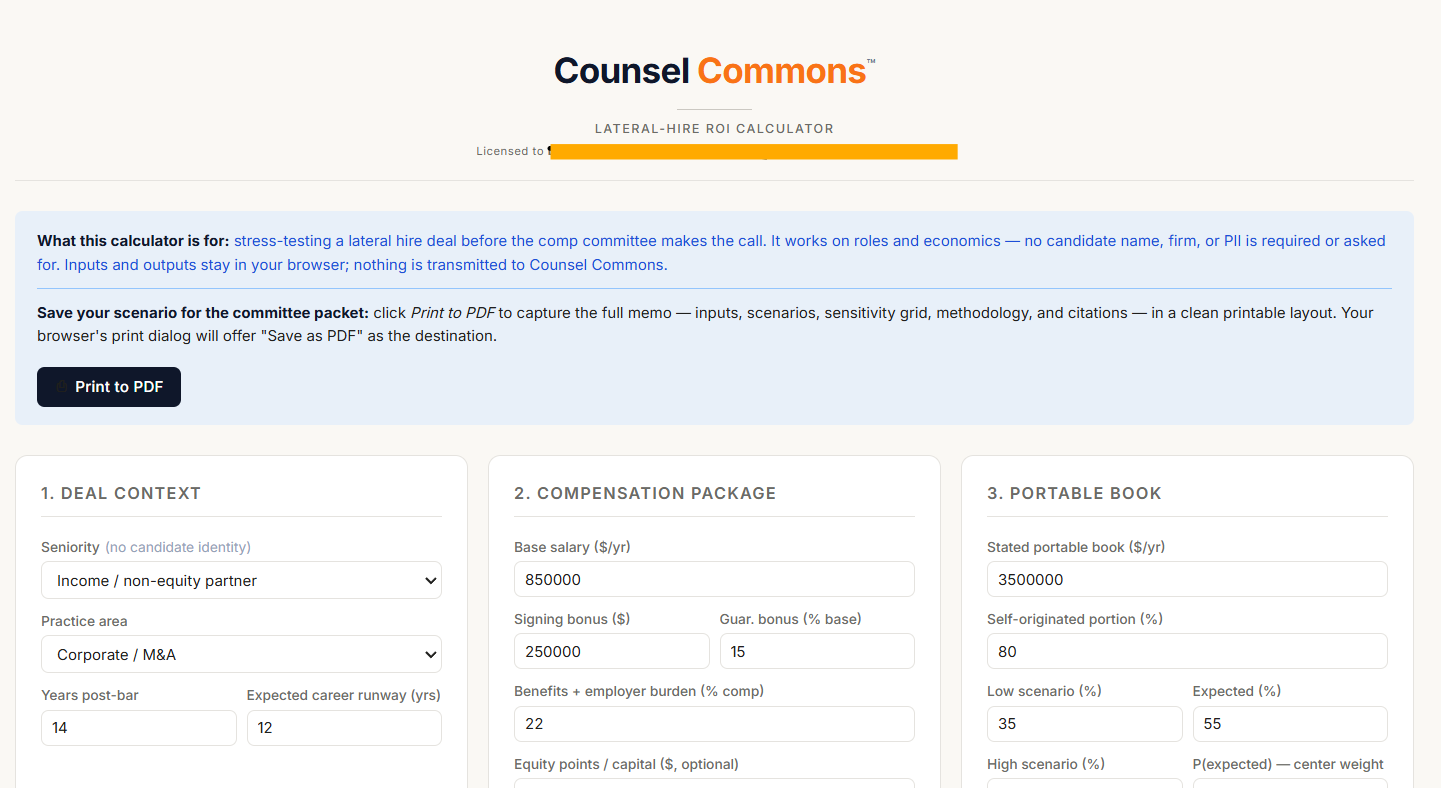
A Corporate / M&A income partner candidate is in late-stage conversation
with the firm. The candidate represents themselves as bringing a sizeable
self-originated book, weighted heavily toward two long-tenured clients.
Career runway is comfortably long. The compensation package on the table
is mid-eight-figures over three years on a cash basis plus a meaningful
signing bonus, with a guaranteed-bonus floor and a standard benefits load.

Open questions the comp committee wants stress-tested before the next
session:

  - Is the asking package defensible given a realistic, not stated, book
    transition? The committee has heard stories from peer firms about
    laterals bringing materially less than promised and is no longer
    willing to underwrite stated-book numbers at face value.

  - What share of the stated book does the candidate actually need to
    move for the deal to net positive over three years?

  - How does the picture change if realization on the inherited matters
    runs at the firm's typical 90–92% rather than the candidate's
    stated 95%+?

  - Two flagged concerns from the recruiter's diligence summary need
    to be reflected in the model: (1) the book is highly concentrated
    in the candidate's top two clients, and (2) there are no written
    client commitments to follow.

  - What downside protection — clawback, sliding scale, attestation —
    is appropriate given the answers above?

No candidate name, current firm, or client identifiers are entered.
Inputs to the calculator are role-level: seniority, practice, the
economic terms on the table, and the diligence-flagged risks. The
committee wants a one-page memo it can review in fifteen minutes and
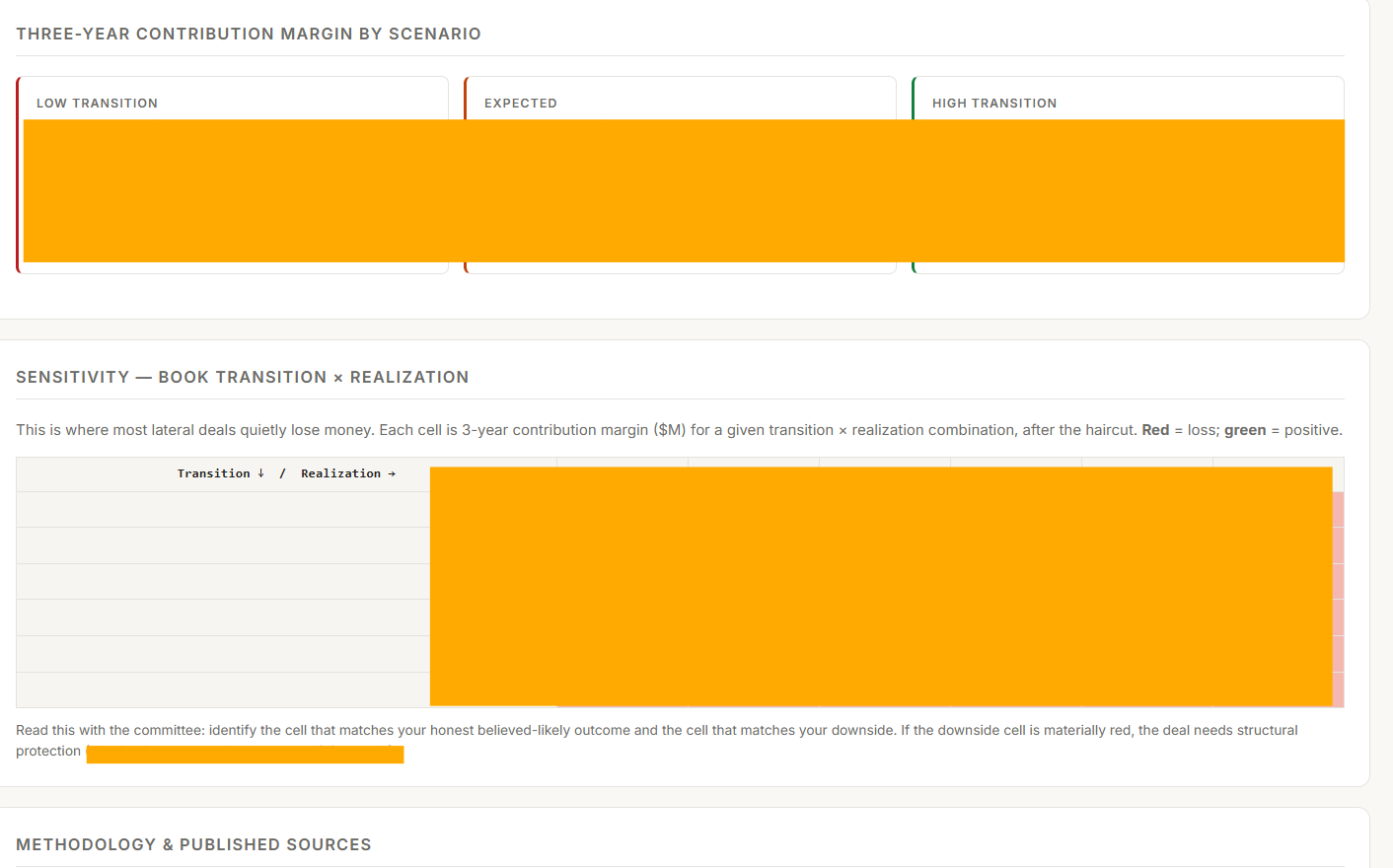
discuss in another twenty.Produced a one-page committee pre-read. Headline finding on the page: the deal requires the candidate to transition a notably higher share of the stated book than the published industry median, just to net positive over three years. The two diligence-flagged risks (client concentration, no written commitments) materially shifted the required share upward — the calculator surfaced what the required share would have been without those flags, so the committee can see how much of the gap is candidate-attributable versus structural. The three-scenario view showed the expected case sitting close to break-even, the low case meaningfully negative, and the high case positive but not transformative. The probability-weighted view came in slightly negative under the committee's own probability weights, and the calculator reported the share of scenario probability that produces a net loss. Both numbers are footnoted to the published research the defaults are calibrated against, with source citations visible on the printed page. The sensitivity view — how the three-year picture moves as the actual transition rate and the realization rate vary independently — let the committee see at a glance where the deal turns from red to green. The committee identified the cell that matched their honest believed-likely outcome and the cell that matched their downside, and confirmed the downside cell was materially negative. A short framing section at the bottom of the page reminded the committee what the calculator does not tell them: whether this specific candidate will be in the top half of laterals, whether references support the stated book, whether work-product samples look strong, and whether bar-clearance and conflicts review have landed. The page closed with a structural-protection menu (clawback, sliding-scale guarantee tied to realized book at month twelve, named- client attestation) keyed to the magnitude of the gap the calculator found. The committee chair printed the page to PDF for the packet and moved to the next agenda item. Total time in the calculator: under fifteen minutes. Outputs require professional review. Industry benchmarks are aggregates; the calculator is a structured stress-test, not a prediction of any individual candidate's outcome.
Section of lateral hire ROI calculator
Another section of lateral hire ROI calculator
Sanitized example, not professional advice. All sales final — use the preview to confirm fit before purchase.
Compatible models
The author has tested this tool on the providers below. The specific model list updates automatically as providers ship new models or retire old ones. Compatibility with providers not listed below is not guaranteed — the tool may not produce equivalent results outside the tested set.
Data handling
Seller of record
- Business name
- Legal InnovAI LLC
- Entity type
- Verified business (Stripe-KYC'd)
- Location
- Colorado
This is the party you have a software-license contract with. If you aren't satisfied with the tool, please contact this party directly to work it out.
Version history
- v1.0.1Current2026-05-26
remove Google Fonts, tighten CSP to zero third-party origins
- v1.0.02026-05-14
Existing buyers receive new versions free of charge. Pin to a specific version from your library if your workflow needs the exact bundle behavior of an earlier release.
Buyer reviews
No reviews yet — be the first after you buy.
- Tools are starting points, like templates. Read every file in the bundle before running, modify for your workflow, and assess safety and legal implications for your use case.
- Outputs vary run-to-run. Generative AI is non-deterministic by design — the same tool on the same input can produce different results, and outputs can vary across sessions, model versions, and provider load conditions. Your input will differ and your model may differ, so you should expect your output to vary from the example above. Variance is normal, not a defect.
- All sales final. Tools are immediately downloadable digital goods.