Law Firm Malpractice Insurance Comparer
ByLegal InnovAI LLCFirm Leadership·Law Firm / Legal Business Management·Jurisdiction-neutral in the US
About this tool
This skill is a structured analyzer for lawyers professional liability (LPL) insurance — also called legal malpractice insurance or "E&O" coverage. It's built for U.S. law firms (and the people who work with them — brokers, in-house counsel, firm administrators) facing a moment where they need to actually understand what's in a policy or what's different between two of them: a renewal cycle, a competitive quote bake-off, a switch in carriers, or a routine but high-stakes review before binding new coverage. The audience is two-tiered, and the deliverable reflects that. A non-lawyer firm executive like a COO or a firm administrator, or a managing partner who isn't an insurance specialist, needs a readable summary that tells them where the meaningful differences are and what they should put in front of counsel. A qualified insurance or contracts attorney then needs a denser, cite-anchored work product they can review before any binding decision gets made. The skill produces both audiences' versions in coordinated form, designed so the executive can hand the package directly to the attorney and the attorney can navigate it efficiently. Importantly, the skill is observational, not interpretive. It does not pick a winner, recommend which policy to bind, predict coverage outcomes, or pronounce a provision "favorable" or "adequate." Its job is to organize what each policy actually says, point to the language that says it, surface where policies differ or are silent, and flag spots that warrant attention — leaving the legal interpretation to the reviewing attorney. This is a deliberate constraint, enforced by strict phrasing rules throughout the output to avoid the possibility of UPL since this skill was created by a non-lawyer with law firm leadership experience. However, your attorney is welcome to feed the outputs of this skill into AI and request it produce an interpretive spin to work from. It handles a few flavors of the same underlying task. Comparing alternative quotes side by side is the default. It also handles a renewal-mode review — what changed between an expiring policy and the renewal quote on the table — and a single-policy review benchmarked against the skill's reference categories rather than against another policy. It can pull in cross-checks against the firm's insurance application and against representations made by the broker or carrier outside the four corners of the policy itself, both of which are common sources of mismatch and risk that pure policy-to-policy comparison misses. Outputs require professional review
Preview before you buy:
The skill works from policy documents — typically PDF — and is at its best when given the full policy package for each carrier under review: the declarations page, the base policy form, every endorsement attached to that policy, and any quote letter or binder. Endorsements matter enormously; a comparison built from base forms alone is misleading, and the skill refuses to gloss over them.

Beyond the policy documents themselves, the skill benefits from:

The firm's insurance application(s), when available — these get cross-checked against firm-profile answers to surface divergences that could affect coverage.

Any written communications from the broker or underwriter that touch on coverage questions — quote summaries, email confirmations, written records of verbal representations. These get integrated alongside the policy text, with mismatches flagged.

Honest answers to a firm-profile intake at the front of the workflow. The skill needs to know what the firm actually does — practice areas, jurisdictional footprint, client types, prior-acts posture, claim history exposure, structural setup — because that is what makes the analysis specific to this firm rather than a generic comparison. A shorter intake is offered on request, with a clear warning that the shorter form degrades the analysis.

The skill performs less well when given fragmentary inputs — a declarations page without the base form, a base form without endorsements, scanned policies of poor image quality. It handles these by being explicit in the output about what couldn't be located or read, rather than guessing.
The deliverable is a coordinated pair of files. A Word executive memo is the entry point — narrative, readable, organized so a non-lawyer can follow it, ending with a list of items flagged for counsel's review. An Excel workbook sits behind it as the working document for the reviewing attorney — a row-by-row comparison matrix, supporting sheets for endorsements, applications, broker communications, and firm-profile inputs, plus methodology and disclaimer material.

Every substantive statement in either file carries a pin cite back to the specific policy language it rests on — carrier, policy number, document (base form or specific endorsement), page, section, paragraph, and a pull-quote of the operative text. Where the policy is silent on something the reference categories cover, the output says so explicitly rather than inferring. Every populated row carries confidence labels on several independent axes, so the reviewing attorney can see at a glance how much weight to put on each line.

Flags throughout the output are always framed as items for counsel to review rather than conclusions. Mandatory disclaimers appear in fixed locations. The Word memo and Excel workbook are linked by a shared ID convention so the attorney can move fluidly between the narrative and the supporting matrix.

What you will not get from this skill:

a ranking, a recommendation, a prediction about whether a claim would be covered, or a judgment that one policy is broader, narrower, better, or worse than another. Those are calls for the attorney reviewing the package — the skill's contribution is making that review fast, organized, and grounded in cites.
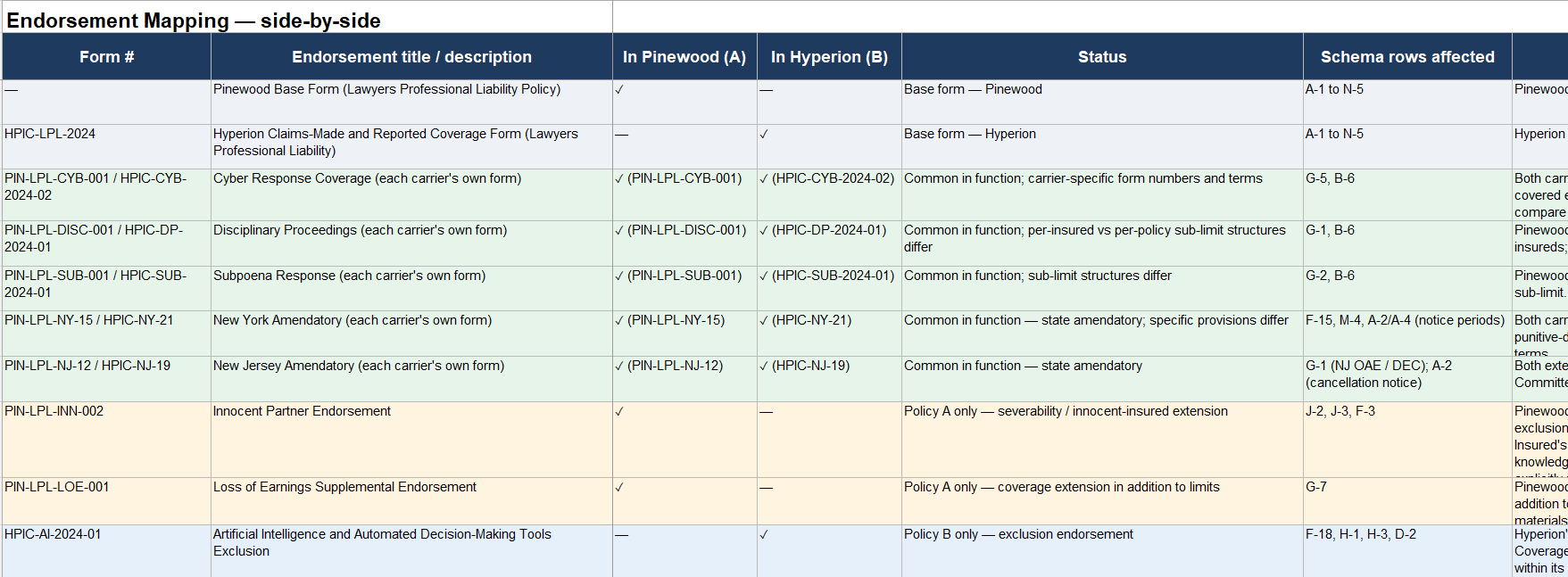
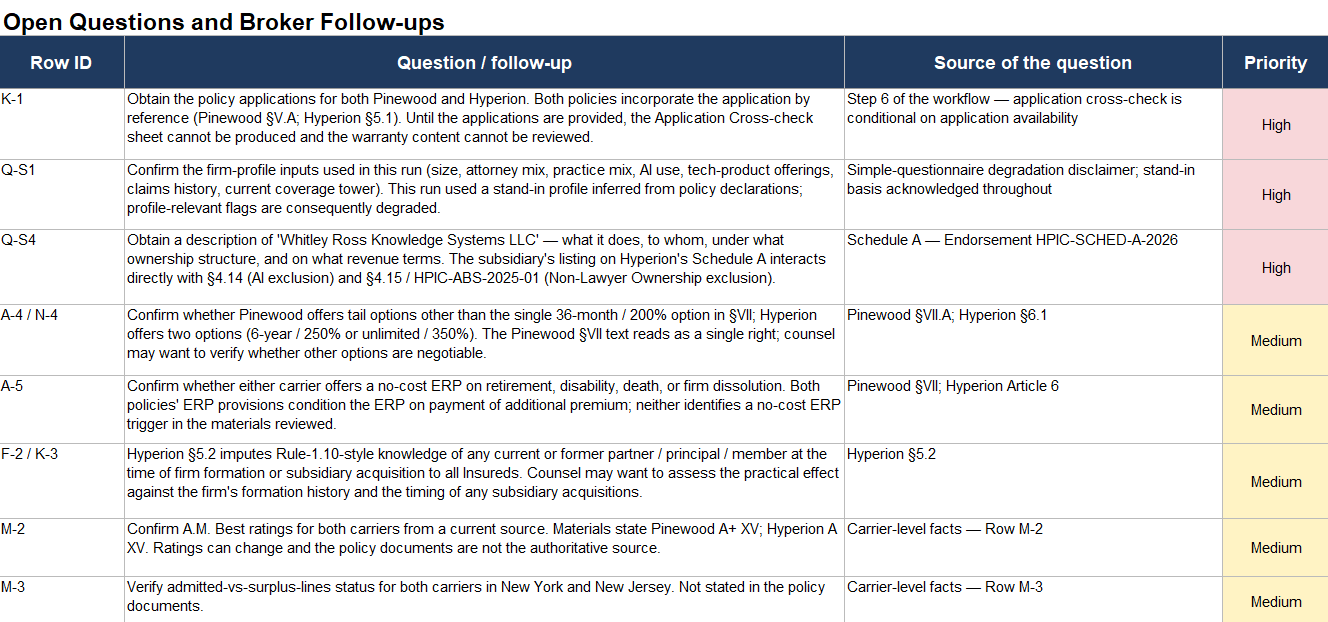
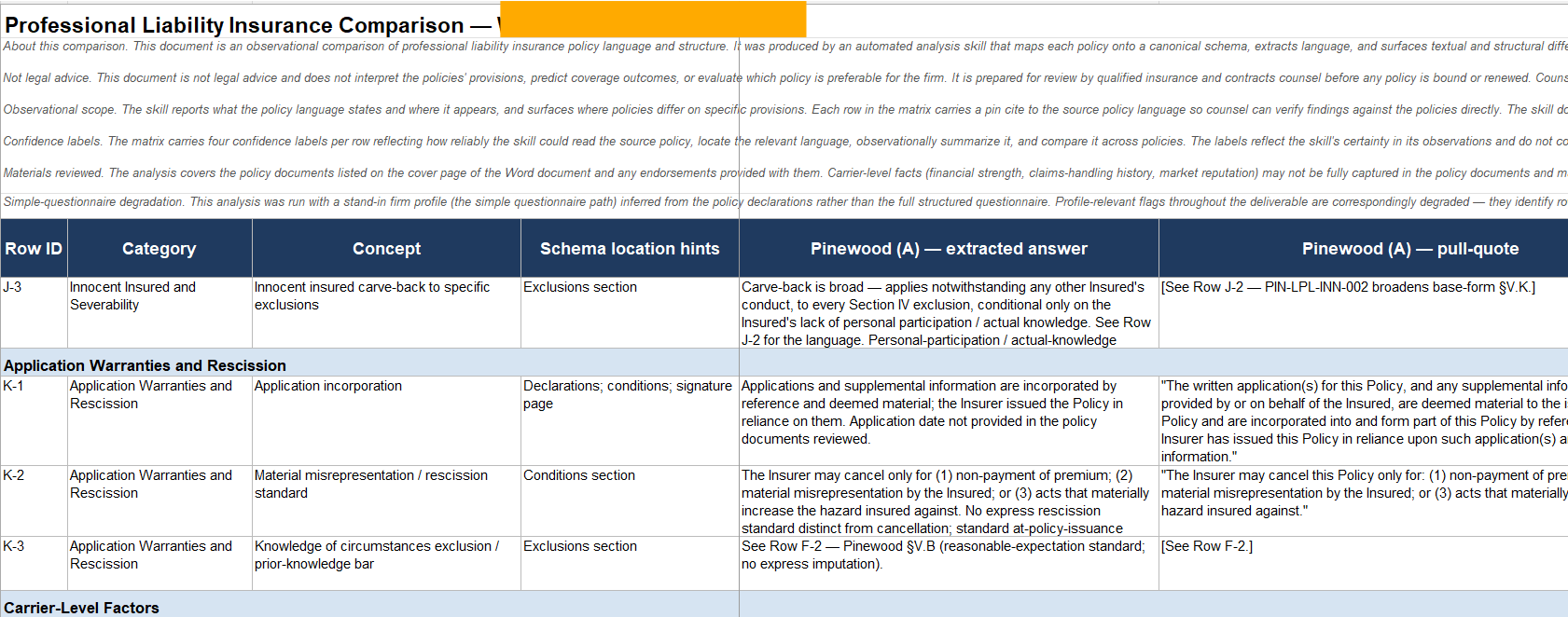
Sanitized example, not professional advice. All sales final — use the preview to confirm fit before purchase.
Compatible models
The author has tested this tool on the providers below. The specific model list updates automatically as providers ship new models or retire old ones. Compatibility with providers not listed below is not guaranteed — the tool may not produce equivalent results outside the tested set.
Data handling
Seller of record
- Business name
- Legal InnovAI LLC
- Entity type
- Verified business (Stripe-KYC'd)
- Location
- Colorado
This is the party you have a software-license contract with. If you aren't satisfied with the tool, please contact this party directly to work it out.
Version history
- v1.0.0Current2026-05-19
Existing buyers receive new versions free of charge. Pin to a specific version from your library if your workflow needs the exact bundle behavior of an earlier release.
Buyer reviews
No reviews yet — be the first after you buy.
- Tools are starting points, like templates. Read every file in the bundle before running, modify for your workflow, and assess safety and legal implications for your use case.
- Outputs vary run-to-run. Generative AI is non-deterministic by design — the same tool on the same input can produce different results, and outputs can vary across sessions, model versions, and provider load conditions. Your input will differ and your model may differ, so you should expect your output to vary from the example above. Variance is normal, not a defect.
- All sales final. Tools are immediately downloadable digital goods.