Partner Pay Equity Analysis
ByLegal InnovAI LLCLegal Operations·Law Firm / Legal Business Management·Jurisdiction-neutral
About this tool
Use this tool to see if your partnership may have a gender pay gap problem; provides near-immediate results and can help you decide whether to hire a professional to run a separate analysis. Partner Pay Equity Analysis is a structured, multi-method statistical audit of partner compensation. It produces an Excel workbook (and an optional Word memo) covering: the unadjusted gender pay gap, a specification-curve adjusted gap across plausible model variants, mediation analysis through origination credit, an Oaxaca-Blinder decomposition (explained vs unexplained), quantile regression across the comp distribution, panel fixed-effects on a multi-year window, and intersectional gender-and-race analysis where the data supports it. The skill adapts its model to the firm's compensation system — lockstep, modified-lockstep, or eat-what-you-kill — and surfaces re-identification risk, sample-size limits, and privilege framing before running. Every figure is shipped with a plain-language explainer so the recipient is not handed coefficients without a frame. Audience: managing partners, compensation committee chairs, general counsel, COOs, and firm administrators conducting an internal comp-equity review. Unit of analysis is the partnership or a defined cohort, for a single comp year or a multi-year panel. What this skill does NOT do: it does not return a verdict of discrimination, it does not analyze associate or staff pay, and it does not handle promotion / headcount / non-compensation HR questions. The output is structured statistical evidence — input to a privileged, professionally-led pay-equity assessment, not a substitute for one. Outputs require professional review by qualified counsel, statisticians, or compensation specialists before any internal or external use.
Preview before you buy:
Firm: 142-partner US multi-office firm; modified-lockstep + origination overlay. Three comp years (2023, 2024, 2025). Each row: partner_id, comp_year, legal_sex, gender_identity, race, cohort_year, tier, equity_points, practice_group, office, leadership_role, originations, billed_hours, total_comp, plus the four comp components (scale, discretionary, origination, capital return).

Audit scope: gender pay gap on total_comp; intersectional gender-and-race where cell sizes allow; specification curve across {with/without origination, with/without tenure, with/without practice-group fixed effects}; Oaxaca-Blinder on the 2025 cross-section; panel fixed-effects on the three-year window.

Privilege: under-counsel direction; output is privileged work product, not a public report.Headline finding: On the 2025 cross-section, women partners earn meaningfully less in total compensation than men. Controlling for cohort, tier, equity points, practice group, office, origination credit, and hours worked, the gap narrows substantially but does not close — a residual difference remains that the standard controls cannot explain. Robustness: The specification curve runs the model across hundreds of defensible variant combinations (with and without origination credit, tenure, practice-group fixed effects, and so on). The direction of the gap is stable: a clear majority of variants return the same sign, and the central estimate sits in a narrow band. The finding is not an artifact of one modeling choice. Decomposition (Oaxaca-Blinder): A majority of the raw gap is "explained" by differences in observable composition between the men and women partner groups — most prominently differences in origination credit and cohort year. A meaningful minority of the gap is "unexplained" by those observables. The skill flags this as structural, not causal. Unexplained does not mean discriminatory; it means the standard pay-determinants the model can see do not account for the residual difference. Distributional shape (quantile regression): The gap is not uniform across the partnership. It is largest at the top of the compensation distribution — concentrated in the equity-partner book — and smaller in the middle and lower bands. This pattern is consistent with the unexplained residual sitting in discretionary or origination-driven comp components rather than in scale-component comp. Multi-year panel: Across the three-year window, the within-partner fixed-effects estimate of the gender coefficient is consistent with the cross-section. The result is not driven by a single year's hiring or attrition cohort. Intersectional view: Cell sizes for Black women and Latina women partners are too small for stable point estimates in this firm's 2025 data (flagged INSUFFICIENT SAMPLE in two of the three years). The skill does not report a number where the sample cannot support one. The committee should treat the intersectional question as open, not as zero. Reading note: The output is structured statistical evidence, not a verdict of discrimination. The decomposition's "unexplained" share is the right starting point for a privileged committee deliberation — it is not, on its own, a finding of fault. The numerical detail behind every claim above lives in the Excel workbook with formulas exposed; the Word memo carries the prose version with the same caveats. Outputs require professional review.
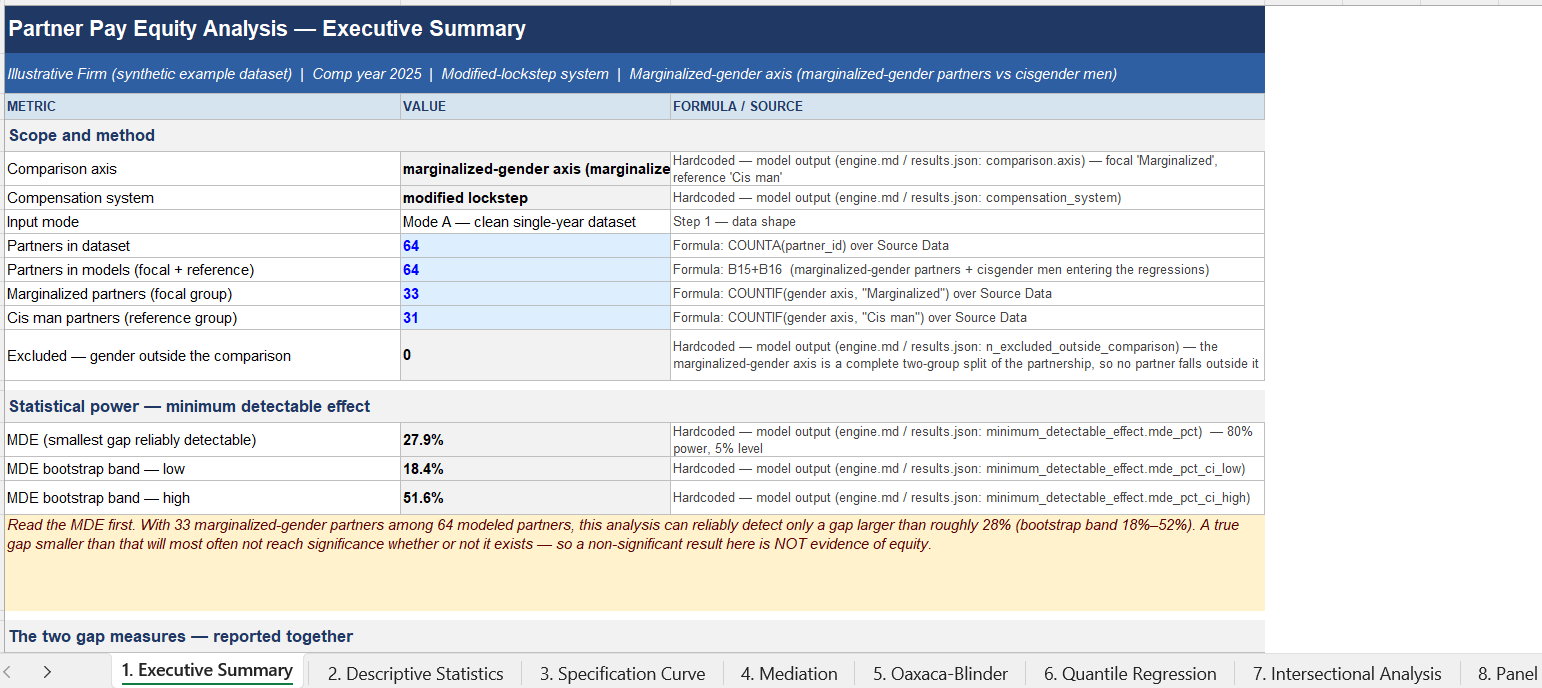
Part of Executive Summary tab
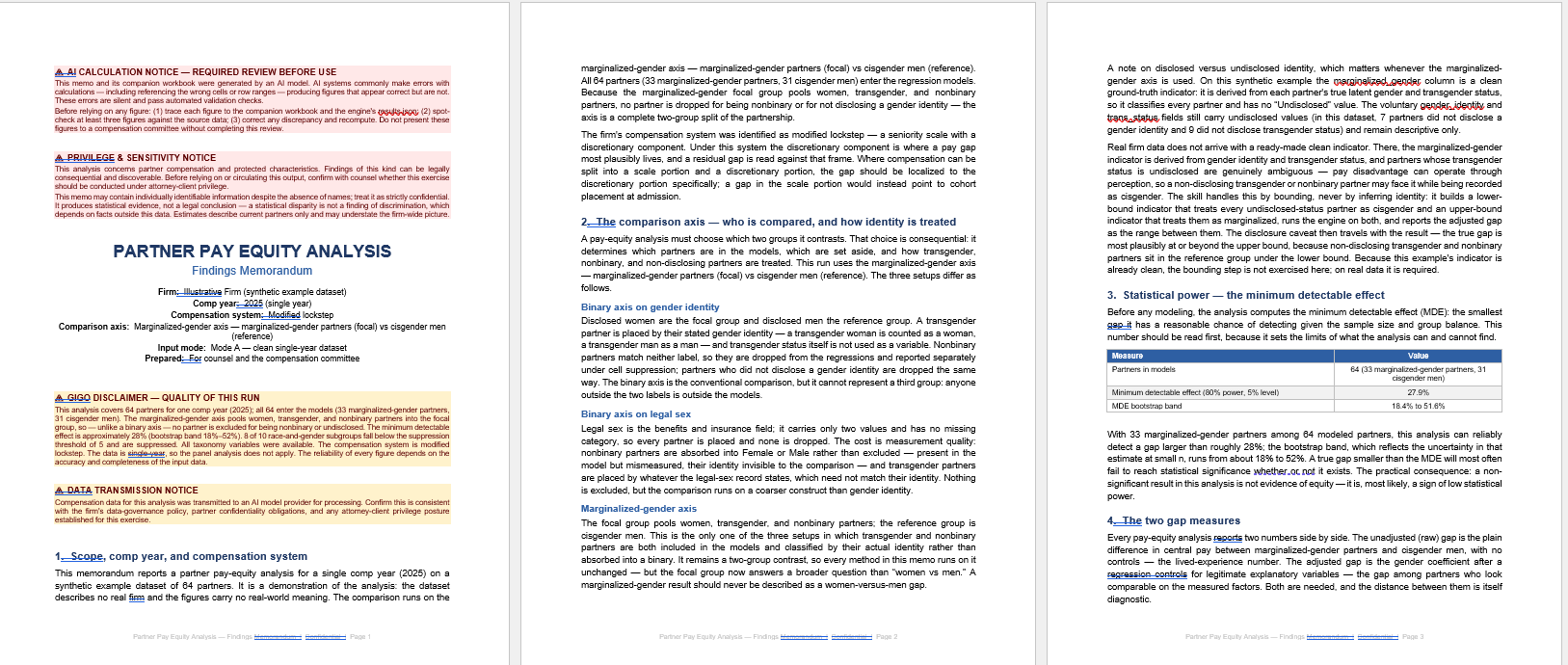
Beginning of Pay Analysis Memo
Sanitized example, not professional advice. All sales final — use the preview to confirm fit before purchase.
Compatible models
The author has tested this tool on the providers below. The specific model list updates automatically as providers ship new models or retire old ones. Compatibility with providers not listed below is not guaranteed — the tool may not produce equivalent results outside the tested set.
Data handling
Seller of record
- Business name
- Legal InnovAI LLC
- Entity type
- Verified business (Stripe-KYC'd)
- Location
- Colorado
This is the party you have a software-license contract with. If you aren't satisfied with the tool, please contact this party directly to work it out.
Version history
- v1.0.1Current2026-05-23
accommodates smaller partner datasets without breaking
- v1.0.02026-05-22
Existing buyers receive new versions free of charge. Pin to a specific version from your library if your workflow needs the exact bundle behavior of an earlier release.
Buyer reviews
No reviews yet — be the first after you buy.
- Tools are starting points, like templates. Read every file in the bundle before running, modify for your workflow, and assess safety and legal implications for your use case.
- Outputs vary run-to-run. Generative AI is non-deterministic by design — the same tool on the same input can produce different results, and outputs can vary across sessions, model versions, and provider load conditions. Your input will differ and your model may differ, so you should expect your output to vary from the example above. Variance is normal, not a defect.
- All sales final. Tools are immediately downloadable digital goods.