Pivot: The Law Firm Strategy Simulator
ByLegal InnovAI LLCStrategy·Law Firm / Legal Business Management·Jurisdiction-neutral
About this tool
Pivot is a hosted, browser-based strategy exercise built for the people who run the firm — managing partners, executive-committee members, COOs, practice-group leaders, strategy and operations leads. It exists to help leaders stay sharp in an industry that won't stop changing. It's like a role playing game, choose-your-own-adventure, and strategic pivot practice all in one. WHAT YOU DO. Configure a fictional firm (size tier, financial posture, AI maturity, leverage model, geographic footprint, top-of-mind concerns), assemble an advisory team from a catalog of 22 firm-leadership roles and tune each advisor's temperament across four personality axes, then play through a compressed multi-year horizon of consequential decisions. AI disruption, client rate pressure, talent crises, governance flashpoints, and partner-level and external shocks are woven through. None of the scenarios touch your real firm, clients, or matters. WHAT YOU GET. A multi-section personalized set of strategic guidance points and decision-audit report, generated in-browser the moment the exercise ends. It includes an executive summary written to your specific simulated scenario and decisions; a Strategic Posture analysis that classifies the posture your decisions actually produced and surfaces the gap between how you explained your choices and what they optimized for in dimensions you couldn't see while steering; an Archetype classification with structural blind spots cited to specific decisions of yours; Inflection Points the analysis identifies as the moments your trajectory actually turned; a Pre-Mortem Accuracy score comparing your mid-game prediction against what surfaced; a Resource & Hidden-State Trajectory chart; a full Decision Audit for every call, with what it cost in visible and hidden state, the alternatives you didn't take, and the advisory reactions; four Competitor Perspectives speaking in voice about how the market read your firm; and phased Next Actions tied to specific findings. You can replay up to two decisions counterfactually and export the plan to PDF, JSON, or Markdown. WHO IT'S FOR. Strategic-planning offsites, executive-committee development, COO and practice-group-leader preparation, firm-administrator and legal-ops training, and individual leadership reflection. It is most useful when the leader takes their own real firm's current strategic question to the exercise as a private lens — Pivot will not see or store that question, but the gap it surfaces between stated and revealed posture will be the lens to read it through. WHO IT'S NOT FOR. Pivot is a reflection instrument, not an advisory product. HOW IT'S DIFFERENT. Every scenario is anchored in current industry reality — modified Cravath compensation pressure, AI-competence, real world client and talent pressures, and more. The 22 advisors push back when your choices contradict their stated temperament — they will not nod at decisions that make their role harder. The hidden state — strategic coherence, partner trust, cultural integrity, optionality — moves silently with every decision and is revealed only at the end. Its reveal is the point. PRIVACY. Pivot runs entirely in your browser. No sign-in, no LLM key, no model call, no analytics, no network calls of any kind after the page loads. The only outbound request is the initial page load itself, served from counselcommons.com under a strict Content-Security-Policy that prevents the tool from making subsequent network calls — a property buyers can verify in their browser's developer tools. LIMITS. Pivot is a reflective practice exercise, not an evaluation, not a validated psychometric assessment, and not a strategic recommendation for any real firm. Industry-anchored scenarios are realistic but stylized; the trade-offs they model are directional, not predictive of any specific outcome. Outputs require professional review.
Preview before you buy:
Pivot collects two layers of input from you: initial configuration before play begins, then in-game choices during the exercise itself.

CONFIGURATION.  You pick a difficulty mode, then describe a fictional firm — size tier, financial health, AI maturity, leverage model, geographic footprint — and write three top-of-mind concerns in your own words. You then assemble an advisory team of three to ten advisors drawn from a catalog of 22 firm-leadership roles (managing partner, COO, CFO, CIO, CMO, CKO, chief innovation officer, hiring partner, lateral director, comp committee chair, regulatory practice chair, senior rainmaker, next-gen partner, and others). Each advisor's temperament is tuned across four sliders — consultative ↔ decisive, progressive ↔ traditional, risk-averse ↔ risk-seeking, plus a role-specific fourth axis. Advisors can be renamed and given coded names you'll recognize. You also pick a portrait per advisor from procedurally-generated abstract avatars.

IN-GAME DECISIONS.  Each scenario presents you with three to five distinct choices. Before deciding, you may spend visible-state resources to investigate the situation (each investigation reveals different information), consult specific advisors from your team (capped per game so you can't ask everyone everything), and read advisor reactions in the language they speak in. You then pick one decision, select one to three rationale tags explaining your choice, and optionally write your reason in your own words in a one-line free-text box. At the midpoint of the exercise the simulation pauses and asks you to predict the failure modes most likely to define your firm's trajectory — a pre-mortem that is scored against what actually surfaces.

NO REAL DATA.  Real client information, matter names, partner identities, or firm-confidential detail are never collected and have no place in Pivot. The firm name and concerns you enter live only in your browser's session storage and never leave the page.
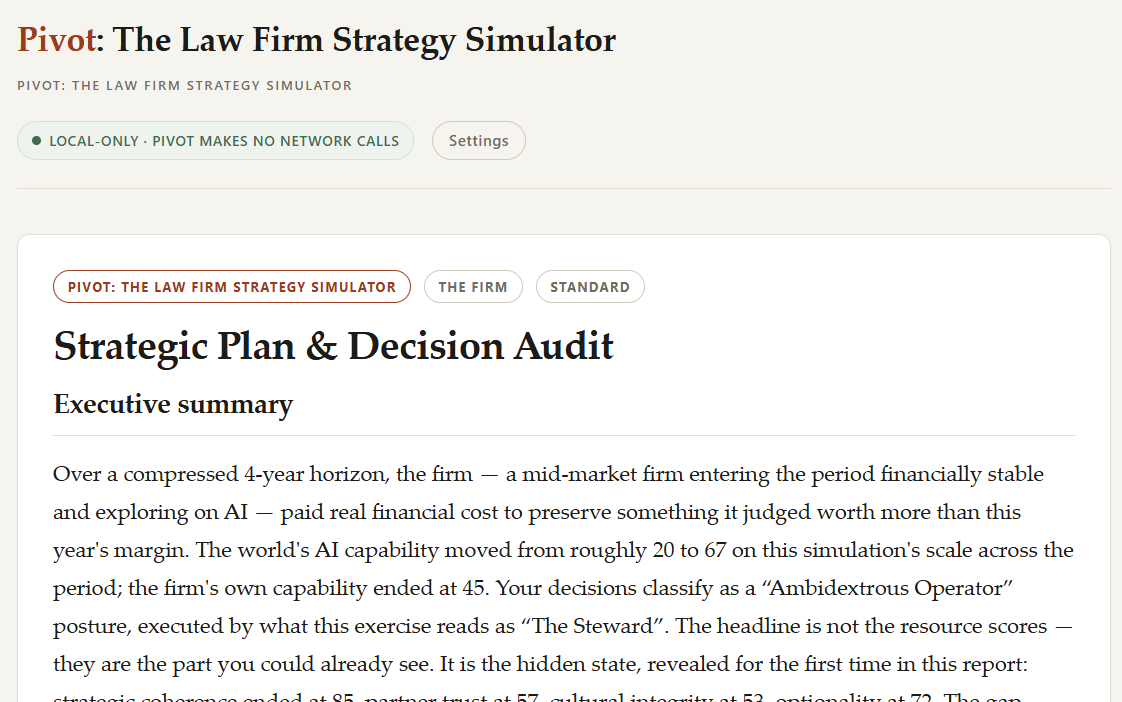
At the end of the exercise Pivot generates a multi-section personalized strategic guidance points and decision audit. The report is written to your specific configured firm and the specific decisions you made — no two reports are alike.

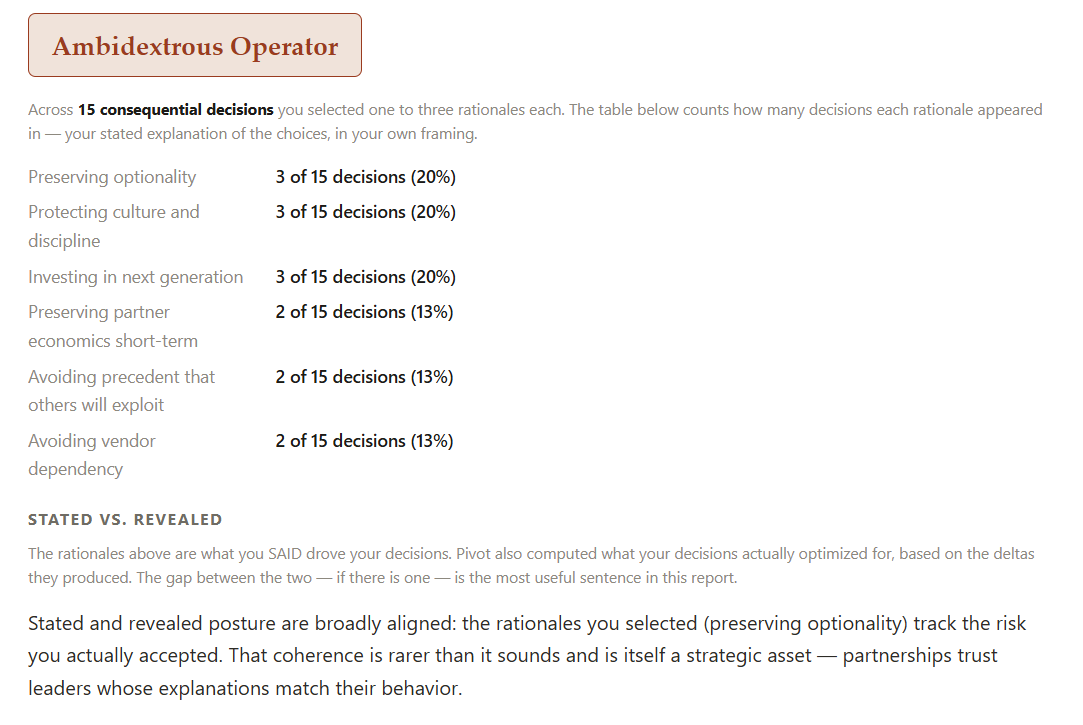
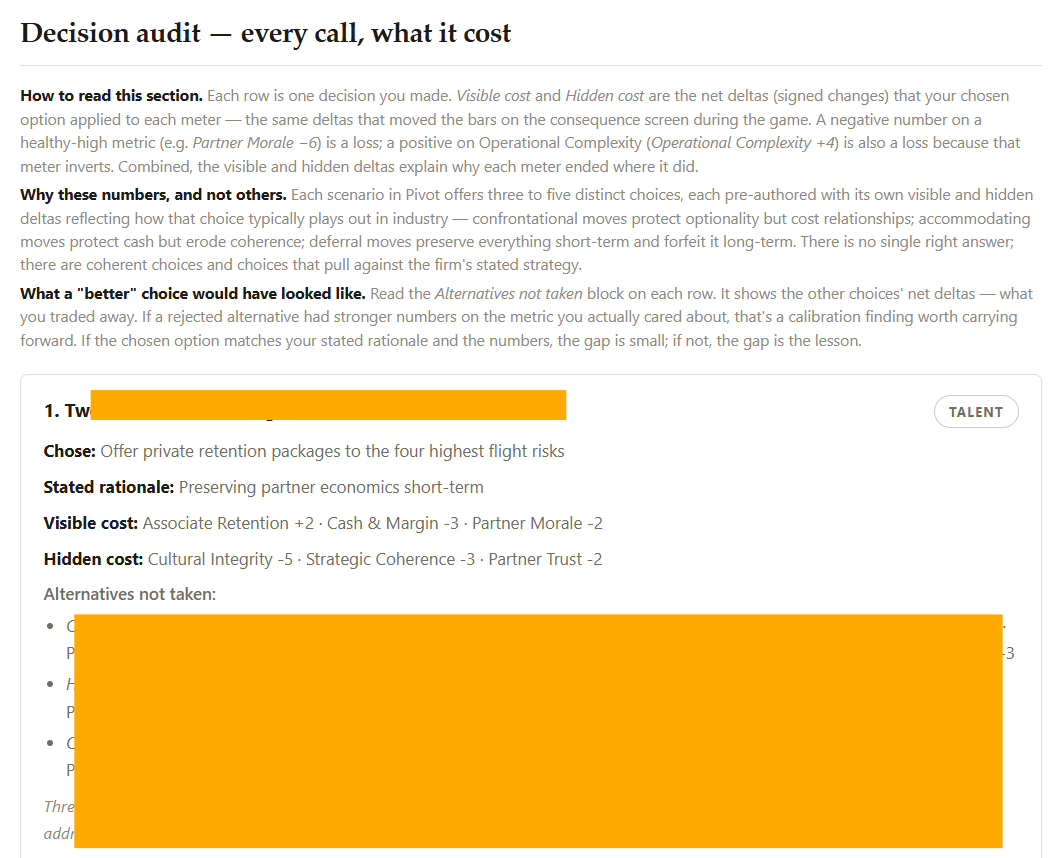
SECTIONS YOU RECEIVE.  An executive summary; a Strategic Posture analysis that classifies the posture your decisions produced (six named postures plus a calibrated fallback) and surfaces the gap between how you explained your choices and what they actually optimized for in dimensions you couldn't see; an Archetype classification (one of eight) with structural blind spots cited to specific decisions of yours; an Inflection Points section that identifies the moments your trajectory actually turned and what they propagated downstream; a Pre-Mortem Accuracy score that compares your midpoint prediction against the failure modes that actually surfaced; a Resource & Hidden-State Trajectory chart showing every meter across every decision; a full Decision Audit for every call (the choice you made, the visible and hidden deltas it produced, the alternatives you didn't take with their deltas for comparison, the advisor reactions, and a narrative consequence note); four Competitor Perspectives — a general counsel, a rival recruiting partner, a senior associate deciding whether to stay, and a consolidation scout — each speaking in voice about how the market read your firm; and phased Next Actions at 90 days, 180 days, and one year, each tied to specific findings rather than generic prescriptions.

THE HIDDEN-STATE REVEAL.  Throughout the exercise, four dimensions — strategic coherence, partner trust, cultural integrity, optionality — move silently with every decision. You do not see them while playing (except in Tutorial mode). They are revealed only in the final report. The gap between the visible meters you steered by and the hidden state you couldn't see is where strategic blind spots live, and surfacing that gap is the point of the exercise.

EXPORT.  The full plan exports to PDF, JSON, and Markdown. The JSON export is intentionally human-readable so you can diff two sessions or share excerpts with a co-leader.

WHAT THIS REPORT IS NOT.  Not a prediction, not an evaluation, not a validated psychometric assessment, not a recommendation for any real firm, and not a substitute for your own strategic judgment. The classification logic, hidden-state weighting, scenario library, archetype taxonomy, advisor-temperament model, and competitor-perspective generation that produce this report are proprietary to the tool and are not exposed in the export.
Sanitized example, not professional advice. All sales final — use the preview to confirm fit before purchase.
Compatible models
The author has tested this tool on the providers below. The specific model list updates automatically as providers ship new models or retire old ones. Compatibility with providers not listed below is not guaranteed — the tool may not produce equivalent results outside the tested set.
Data handling
Seller of record
- Business name
- Legal InnovAI LLC
- Entity type
- Verified business (Stripe-KYC'd)
- Location
- Colorado
This is the party you have a software-license contract with. If you aren't satisfied with the tool, please contact this party directly to work it out.
Version history
- v1.0.0Current2026-05-20
Existing buyers receive new versions free of charge. Pin to a specific version from your library if your workflow needs the exact bundle behavior of an earlier release.
Buyer reviews
No reviews yet — be the first after you buy.
- Tools are starting points, like templates. Read every file in the bundle before running, modify for your workflow, and assess safety and legal implications for your use case.
- Outputs vary run-to-run. Generative AI is non-deterministic by design — the same tool on the same input can produce different results, and outputs can vary across sessions, model versions, and provider load conditions. Your input will differ and your model may differ, so you should expect your output to vary from the example above. Variance is normal, not a defect.
- All sales final. Tools are immediately downloadable digital goods.